Digital help platform vision

I defined the strategy for AI-powered customer support across Intuit — then proved it with Supercharged Search, which drove 2024 Tax Season contact rate to 1.72% against the 2.2% goal.

Customers were overwhelmed by help options that didn't help. Search returned static articles. Reaching a human took clicks. Nothing knew where the customer already was in their journey. Digital help was a destination customers were forced to visit, not a capability that met them where they were.

Challenge.

Four teams were optimizing four surfaces — search, in-product content, the connect-to-expert path, contextual prompts — against four different metrics. The customer felt the gap between them.

Reducing customer effort meant aligning the whole stack on one shared goal instead of optimizing each surface independently. The strategy had to be specific enough that any team could keep executing against it without me in the room.

Help is not a destination. It's a capability that meets the customer where they already are.

Approach.

I framed the strategic layer as "Product Support Done for You" — a unified platform vision for AI-powered, contextual help that handles the customer's request without making them dig for it. The work spanned alignment across business units, executive presentations, and defining the design principles that now govern every initiative on the Digital Help team — when AI answers, when it hands off to an expert.

Supercharged Search was the proof point: four AI-powered variants I designed and tested during peak season, on a platform that runs across both TurboTax and QuickBooks. The Welcome Experience, the other major execution from this strategy, is already showing a 7.5% lift in containment — questions self-served instead of routed to a human — and contributing to the contact-rate improvements below.

Figma board of Supercharged Search variants — Banner, Inline, Badge, Card, Dropdown card, Expert, Inline banner — plus card explorations and SOPs for Discoverability, Upsell Action, and Time.
Four TurboTax search variants — each one a route to the ecosystem product that fits the customer's filing path.
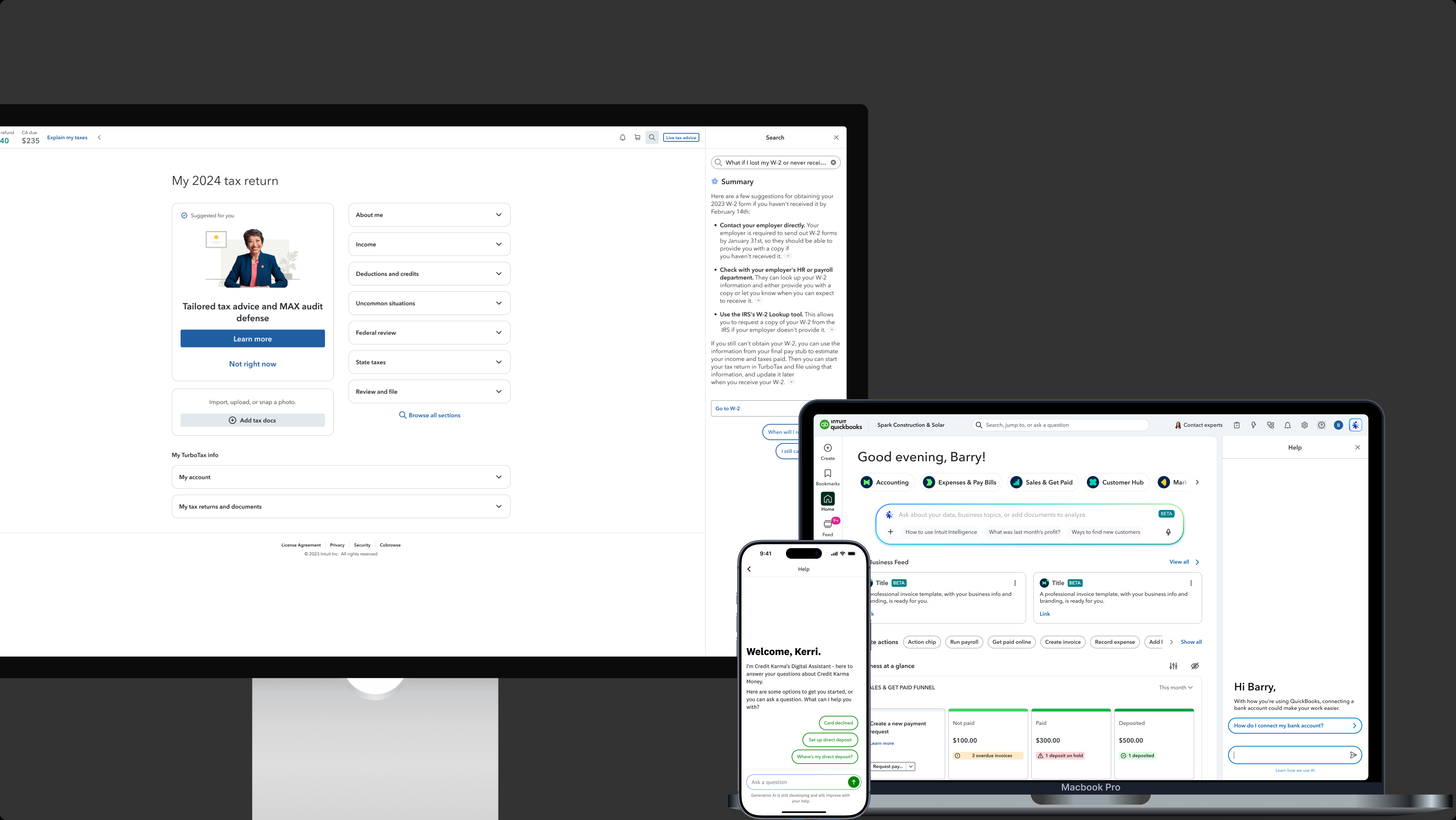
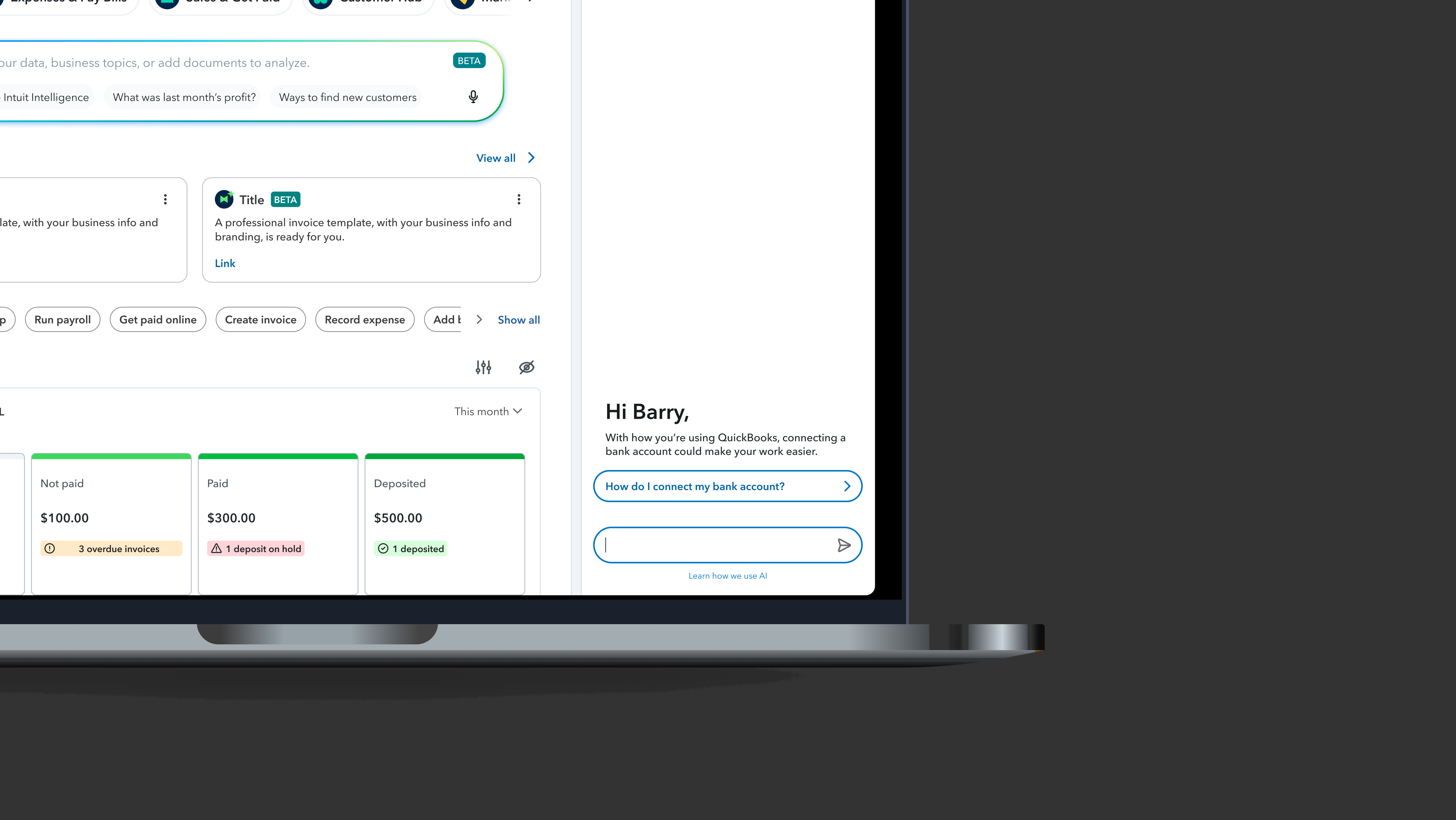
QuickBooks dashboard on a MacBook with the Welcome Experience panel open on the right — a "Hi Barry" greeting noting that, given how he's using QuickBooks, connecting a bank account could make his work easier, with a "How do I connect my bank account?" suggestion and a chat input.
Contextual help that meets the customer on their dashboard — the other major execution from the strategy.
Figma board of TurboTax Digital Help strategy slides — Background and ownership, Risks and benefits, and Design rationale sections, each pairing dark eyebrow tiles with mobile mockups and rationale columns.
The strategy artifact that aligned TurboTax on Product Support Done for You.
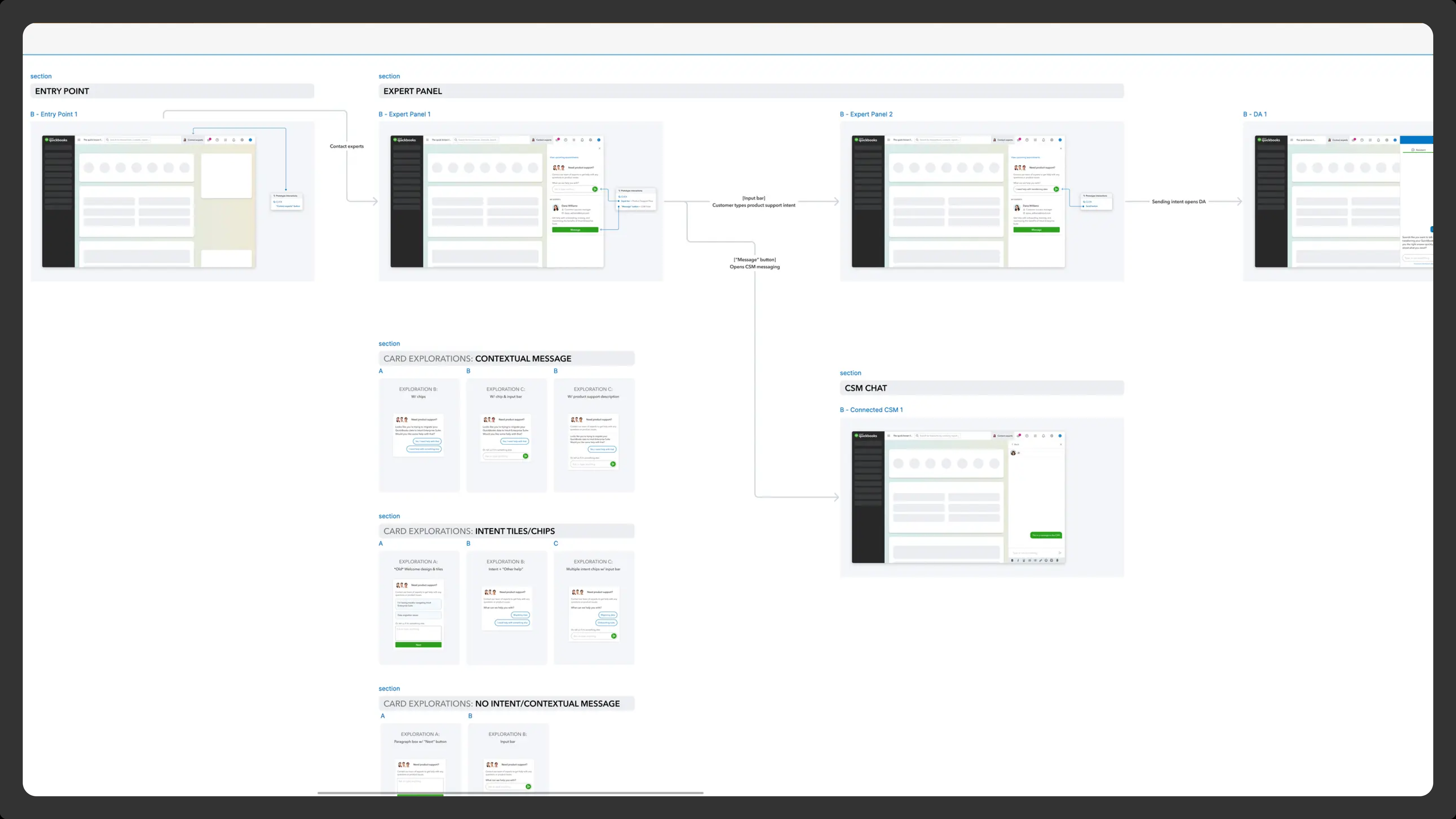
Figma board mapping CSM and Expert Assist flows — Entry Point, Expert Panel 1, Expert Panel 2, CSM Chat — alongside card explorations for contextual messages, intent tiles and chips, and no-intent variants.
The path to a human, redesigned — fewer clicks, more context, no dead ends.
Figma board of Credit Karma Digital Self-Help target state — a large flow chart of the target experience next to an Old vs Target State comparison and an MVP Flow v2 OLD reference.
Same platform pattern across Consumer Group (TurboTax), Global Business Solutions Group (QuickBooks), and Credit Karma.

Outcome.

Consumer Group (TurboTax) contact rate is at 1.72% against a 2.2% goal. Global Business Solutions Group (QuickBooks) is at 1.1% against 1.3%. The Welcome Experience delivered $1.8M in TurboTax revenue and $214K in annualized cost savings. The strategy that drove these numbers is now the operating model the Digital Help team runs on — without me in the room.

What changed.

  • 1.72%

    Consumer Group (TurboTax) contact rate vs. 2.2% goal.

  • 1.1%

    Global Business Solutions Group (QuickBooks) contact rate vs. 1.3% goal.

  • $1.8M

    Consumer Group (TurboTax) revenue impact.

  • $214K

    Annualized cost savings from contact reduction.

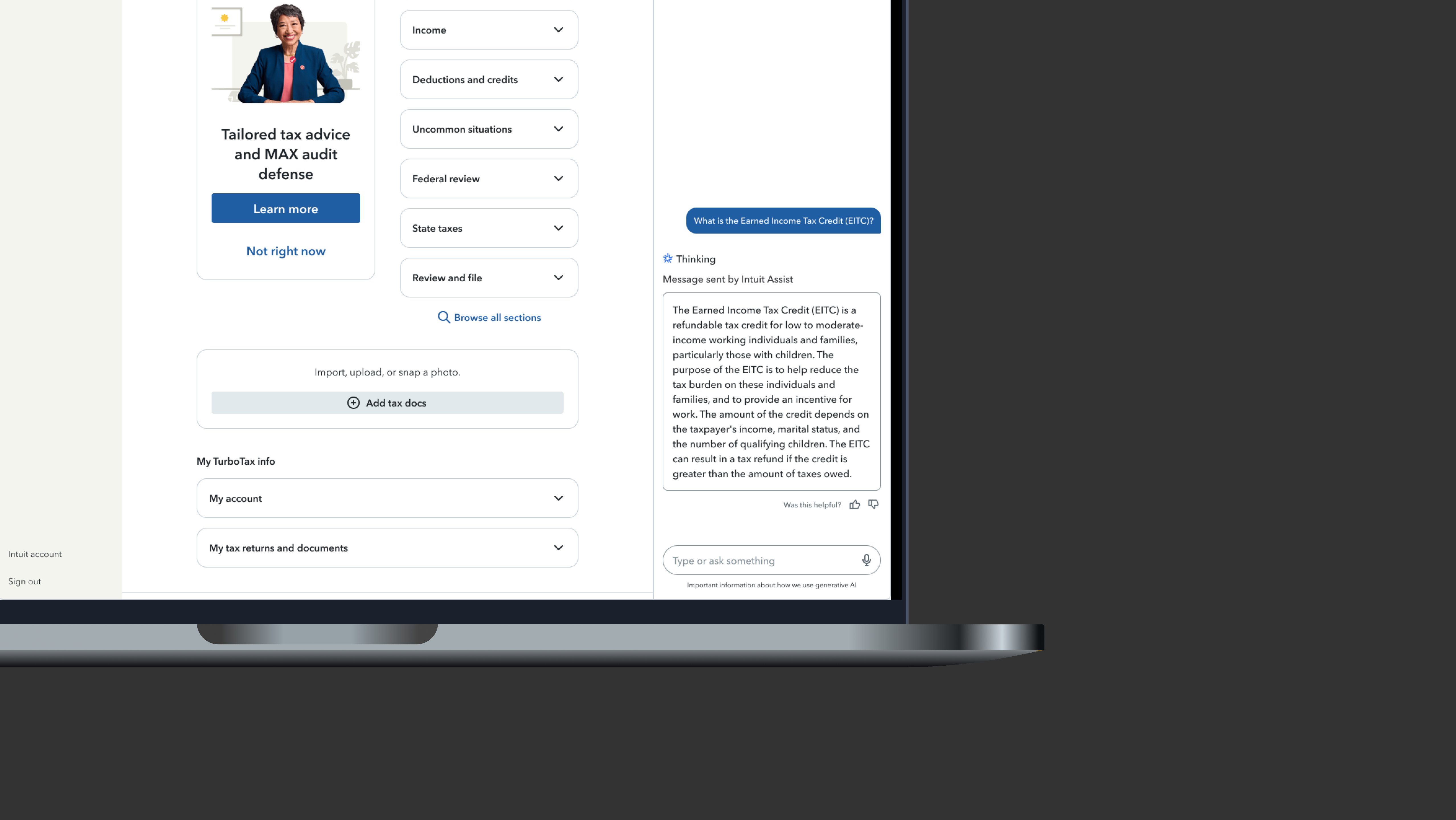
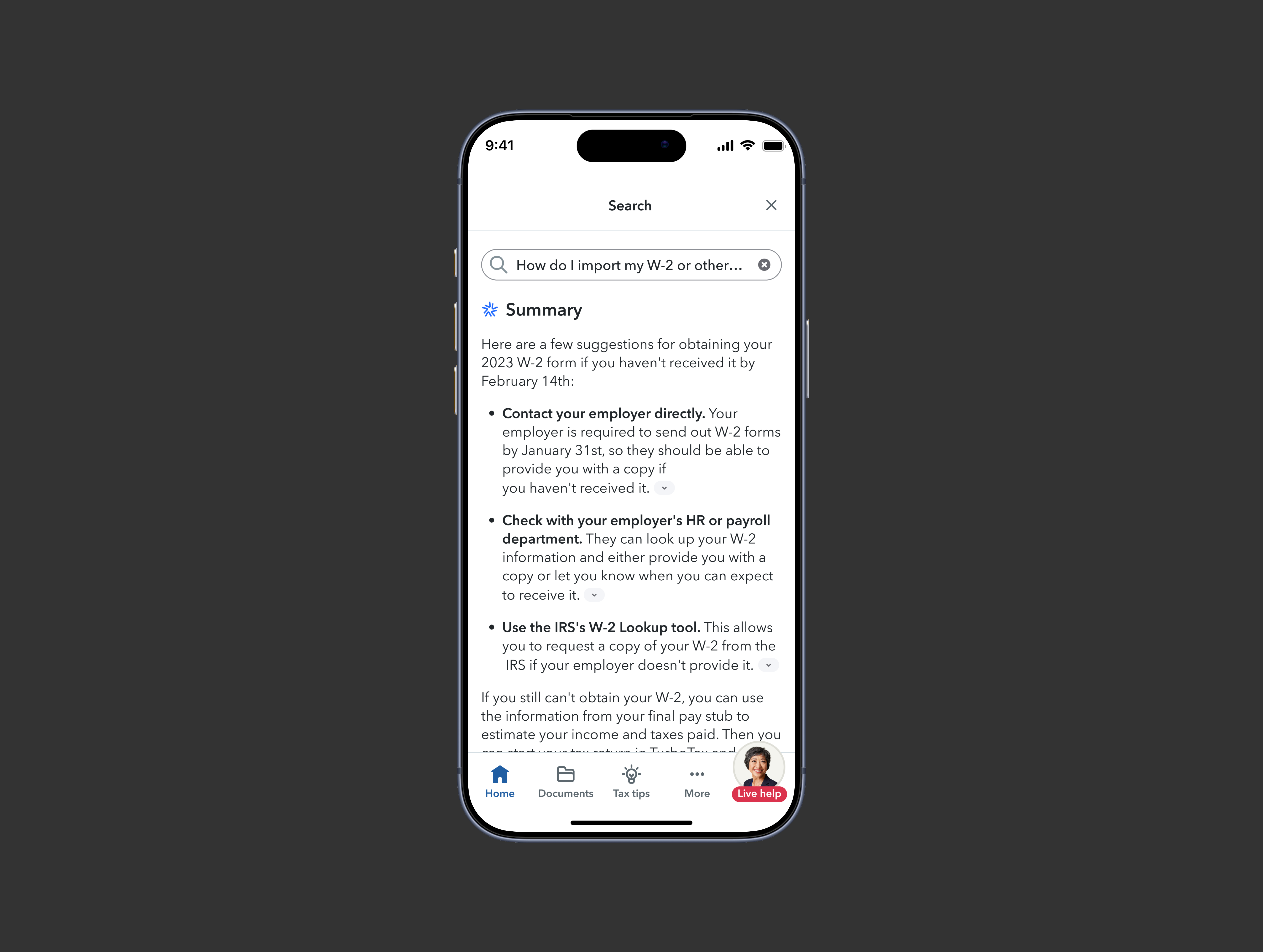
TurboTax desktop showing the My 2024 tax return dashboard with Search open on the right, answering a customer question with a summary response and follow-up question chips.
Search stopped returning articles and started returning answers — with a follow-up.

The most durable output wasn't the search variant or the Welcome Experience. It was a strategy specific enough that the team could keep executing against it after the engagement ended — not a vision deck, but an operating model: when the system answers, when it hands the customer to a person.